Taylor Technologies•Featured Sponsor
Taylor K-2006 Complete DPD-FAS Pool Test Kit
Lab-grade titration kit for accurate Free Chlorine, Total Alkalinity, Calcium & Cyanuric Acid.
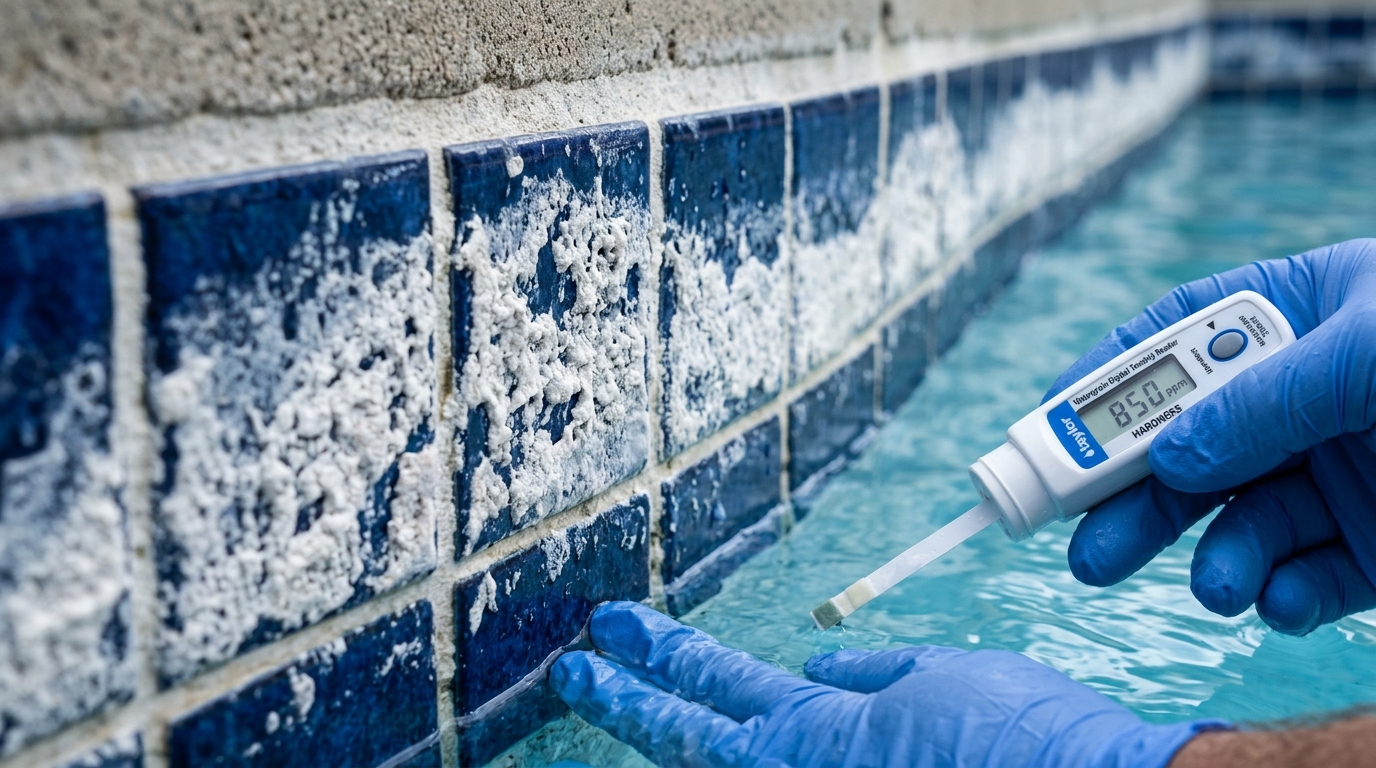
Run your fingers along your pool tile line or gunite plaster floor. If it feels rough like coarse sandpaper or has a chalky white film, your water is super-saturated with Calcium Hardness (CH > 500 ppm).
High calcium ruins expensive gas heater heat exchangers, clogs salt chlorinator cell plates with white rock, and clouds water on hot sunny afternoons. Because calcium does not evaporate, summer evaporation continuously concentrates minerals into dangerous scaling territory.
Calculate the exact percentage and gallons of high-calcium water to replace with fresh tap water to bring your pool back to the 250 ppm safe equilibrium.
Before draining a single drop of pool water, test your garden hose tap water with a calcium titration kit. In areas like Southern California or Texas, municipal tap water often has 200–300 ppm calcium out of the faucet. You can only dilute down to the baseline hardness of your fill source.
Every 1 pound bag of Calcium Hypochlorite (Cal-Hypo) shock you dissolve dumps 6.0 ppm of permanent calcium into 10,000 gallons of water. If your calcium is already elevated, switch strictly to liquid chlorine (sodium hypochlorite), which adds zero calcium hardness.
If a full water drain is not immediately feasible (e.g., in drought-restricted regions or high water-table zones where pools can pop out of the ground), you can temporarily prevent scaling by strictly running your pH at 7.3 to 7.4. Lower pH increases water's acidity, holding excess calcium dissolved in liquid suspension rather than depositing on tile.
Calcium hardness is a key pillar of the Langelier Saturation Index. Use our 0ms dynamic water balance engine to calculate exact chemical additions for your pool and protect equipment.